Blackjack Online: Rules, Demo Games, and Real Money Play

Last updated: September 2026 | Reviewed by: Nisha Rao, Casino Content Editor at Casino and Betting India | Reading time: ~22 minutes

"Before you deposit, always check the withdrawal rules, game contribution rates, and payment processing friction. A high bonus amount means nothing if wagering terms or restrictive payout policies lock your funds." Nisha Rao, Casino Content Editor at Casino and Betting India

Legal and jurisdiction callout (India): Real-money online gaming in India is governed by a mix of national statutes and state legislation, including the Promotion and Regulation of Online Gaming Act, 2025, and the accompanying Promotion and Regulation of Online Gaming Rules, 2026. These references describe current and proposed regulatory frameworks for online real-money gaming in India. Several states, including Telangana, Andhra Pradesh, Tamil Nadu, Assam, and Odisha, apply strict prohibitions on online games played for stakes, while Sikkim, Nagaland, and Meghalaya operate their own licensing regimes. Verify the legal status of online real-money play in your own state, observe age restrictions (18+ or 21+ depending on jurisdiction), and treat this article as general information, not legal advice.

RTP

99.59%

Volatility

Low
Blackjack Online Rules, Demo Games, and

Four Things to Know Before You Play

  1. The rules are fixed, and the maths is not negotiable. Card values (2–10 face value, J/Q/K = 10, Ace = 1 or 11) plus dealer drawing rules decide outcomes. With perfect basic strategy on standard multi-deck rules, the house edge sits between roughly 0.5% and 1.5%. Low, but never zero.
  2. Table rules change the price of every hand. A 3:2 blackjack payout is standard; a 6:5 table adds about +1.39% to the house edge. Dealer Stand on Soft 17 (S17) is better for you than Hit on Soft 17 (H17).
  3. Blackjack is a poor tool for clearing bonuses. Most casinos count blackjack at 10% or less toward wagering requirements. A ₹10,000 bonus at 30x becomes ₹3,000,000 in required bets at a 10% contribution rate.
  4. Demo play is for learning, not for earning. Virtual credits cannot be withdrawn, and no betting system (Martingale, Paroli, or anything else) changes expected value. Set deposit and time limits before your first real-money hand.
Four Things to Know Before You

Who This Guide Is For, and What It Actually Covers

This guide is written for readers in India who want plain answers before they register anywhere. Not marketing language. Not "guaranteed systems".

You will get five practical things:

  • The rules, in order:how a round is dealt, what hit, stand, double, split, and surrender really do, and how the dealer's mandatory draw affects your chances.
  • Format comparison:blackjack demo, classic RNG tables, First Person titles, and live blackjack with a real dealer, including mobile data use.
  • Offer evaluation:how to read wagering terms, contribution rates, and max bet caps before a bonus locks your balance.
  • India-specific payment reality:INR routing, UPI, NetBanking, KYC documents, and the mismatches that freeze withdrawals.
  • Risk control:basic strategy as a loss-reduction tool, why progressive betting fails, and which limits to set before your first deposit.
Who This Guide Is For, and

Read it in order if you are new. If you already know the rules, jump to the payments and bonus maths sections; that is where most money is quietly lost.

Online blackjack is one of the most widely played card games in digital casinos worldwide. It combines simple rules with structured mathematical strategy, which is exactly why it attracts beginners and long-term players alike. Whether you are testing free demo versions, placing small bets on software-based tables, or joining live dealer streams, understanding the mechanics matters before you take any action.

For players in India, casino content also needs local context. Under the Promotion and Regulation of Online Gaming Act, 2025, and the subsequent Promotion and Regulation of Online Gaming Rules, 2026, real-money online gaming is subject to strict regulatory oversight and restrictions. Payment flows involving Indian Rupees (INR), Unified Payments Interface (UPI), and NetBanking also require careful verification of account rules and Know Your Customer (KYC) compliance. This guide breaks down how blackjack works, how each decision affects your expected value, how to evaluate casino offers, how Indian payment rails and verification actually operate, and how to keep full control over your budget.

Online blackjack is one of the

What Is Blackjack and What Is the Object of the Game?

Blackjack is a casino banking card game where each player competes individually against the house, represented by the dealer. The goal in every hand is to build a card total higher than the dealer's total without exceeding 21.

Unlike standard poker, where players compete against one another, your hand in blackjack is evaluated solely against the dealer's hand. The game runs with one or more standard 52-card decks on a dedicated blackjack table. Online, that table appears either through a digital software interface or via a real-time video stream from a studio.

The Object of the Round: Reach 21 or Beat the Dealer

The core objective of a blackjack round is to beat the dealer's total while staying at or below 21 points. Reaching exactly 21 is nice, but it is not required to win the round.

A player wins under three specific conditions:

  1. The player's total is higher than the dealer's final total, without exceeding 21.
  2. The dealer's hand total exceeds 21 (a "bust"), provided the player has not already busted.
  3. The player is dealt a "natural blackjack" (an Ace plus a 10-value card on the first two cards) and the dealer does not hold a natural blackjack.

«A formal game model encodes each player decision as a node in a stochastic, imperfect-information tree, where optimal play is defined by expected payout rather than by reaching 21.» Li et al., A Formal Game-Theoretic Model of Blackjack, SSRN preprint (2024). https://ssrn.com

That distinction matters in practice. Beginners often chase 21 and hit strong totals such as hard 17, when the mathematically correct move is to stand and let the dealer risk the bust. It feels passive. It is not.

A player loses the round if their total exceeds 21, or if the dealer finishes with a higher total without busting. If both sides end with identical totals (18 against 18, for example), the result is a "push" (a tie), and the original wager is returned with no profit or loss. Updated: these win, loss, and push definitions follow the standardised wording used in published regulatory rule sets for casino blackjack, including the blackjack rules issued by the Massachusetts Gaming Commission and operator rule sheets published by Boyd Gaming. Both define bust as any total above 21 and treat identical totals as a push.

That distinction matters in practice. Beginners

Card Values in Blackjack

Card values in blackjack are refreshingly simple, because suit colours and suit types (Spades, Hearts, Diamonds, Clubs) have no mechanical effect on the score. Hand totals are calculated by adding the point value of each card dealt:

  • Cards 2 through 10:worth their printed numerical value (a 4 is worth 4 points, a 9 is worth 9 points).
  • Face cards (Jack, Queen, King):each is worth 10 points. These are collectively called "10-value cards".
  • Ace:flexible. An Ace counts as either 1 point or 11 points, whichever benefits the hand without pushing the total over 21.
Card Values in Blackjack. Card values

When an Ace counts as 11, the hand is a soft hand (Ace + 6 = Soft 17). It is called soft because taking one more card cannot bust you immediately; if a high card arrives, the Ace quietly reverts to 1 (Ace + 6 + 9 = Hard 16). A hand without an Ace, or one where the Ace must count as 1 to stay under 22, is a hard hand (10 + 7 = Hard 17).

What Happens with Blackjack, Busts, and Tied Hands

The exact combination of cards dealt during a round decides both the payout structure and how quickly wagers are settled:

  • Natural blackjack:an initial two-card hand of an Ace plus any 10-value card (10, Jack, Queen, or King). It is an automatic winning hand that traditionally pays 3:2 on the initial bet, so a ₹1,000 bet wins ₹1,500. If the dealer also holds a natural blackjack, the hand is a push.
  • Bust:any total above 21 points. If a player takes an extra card and the sum passes 21, the player busts instantly and loses the bet. Importantly, a busted player wager is forfeited immediately, even if the dealer busts later in the same round. That single rule is where most of the house edge comes from.
  • Push (tie):when player and dealer hold equal non-busted totals under 21, or when both hold natural blackjacks. The original bet is returned to your balance untouched.
What Happens with Blackjack, Busts, and

Table 1: Card values, hand types, and round resolution rules in online blackjack

Card / OutcomeNumerical ValueHand ExampleHand ClassificationOutcome and Payout Mechanics
2 to 10Face value (2–10)8 + 9 = 17Hard handCounts as face value; total cannot be adjusted downwards.
J, Q, K10 points eachKing + 7 = 17Hard handStandard 10-value cards; behave identically to numeric 10s.
Ace1 or 11 pointsAce + 5 = 6 or 16Soft handFlexible valuation; counts as 11 unless the total exceeds 21.
Natural BlackjackExactly 21 (2 cards)Ace + QueenNatural 21Beats standard 21; pays 3:2 (or 6:5 on restrictive tables).
BustOver 21 points10 + 7 + 6 = 23Busted handImmediate loss of wager, processed before the dealer draws.
PushEqual totalsPlayer 19 / Dealer 19Tied handBet returned in full; no net win or loss.

Online, all card values and outcome calculations are processed automatically by the game software. Still, knowing how totals are formed is what lets you make sensible choices during play instead of guessing.

Blackjack Rules: Player Actions and Dealer Moves

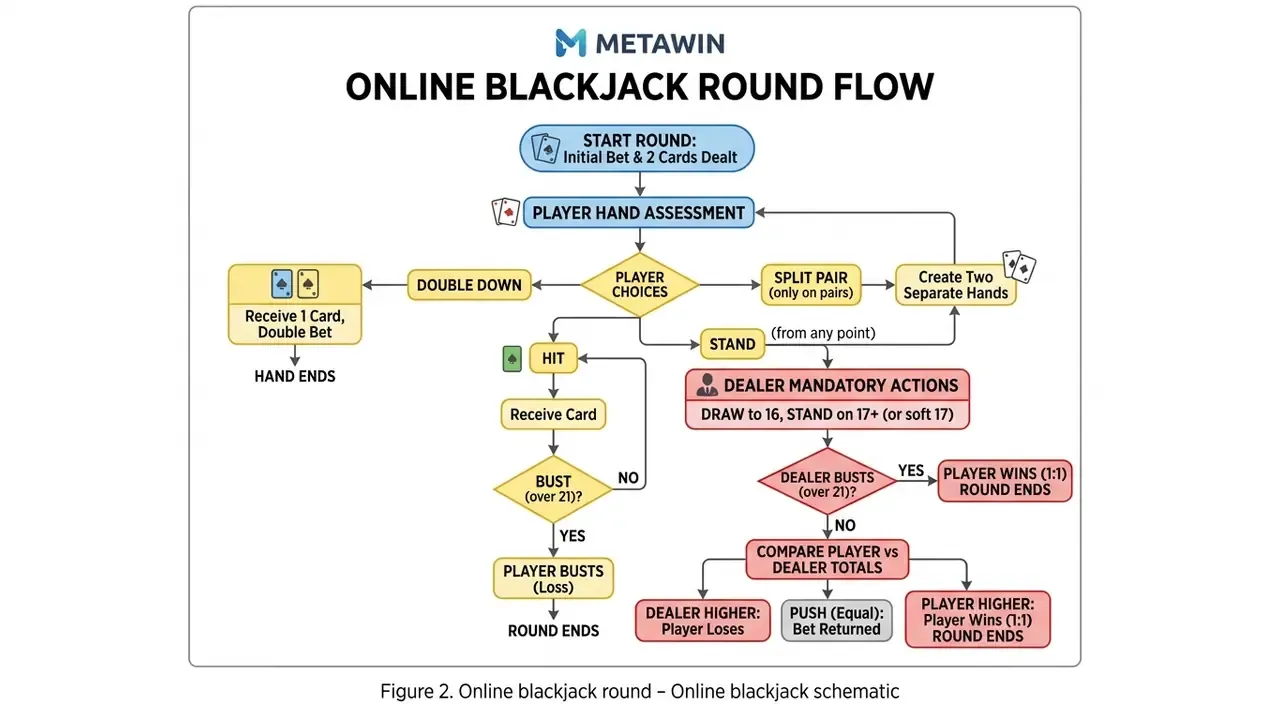
Every round of blackjack follows a strict sequence: initial wagers, the deal, player actions, dealer draws, then payouts. Two rules do most of the heavy lifting for your expected value: the blackjack payout ratio and the dealer's soft-17 instruction.

How to Place a Blackjack Bet and Receive Your First Cards

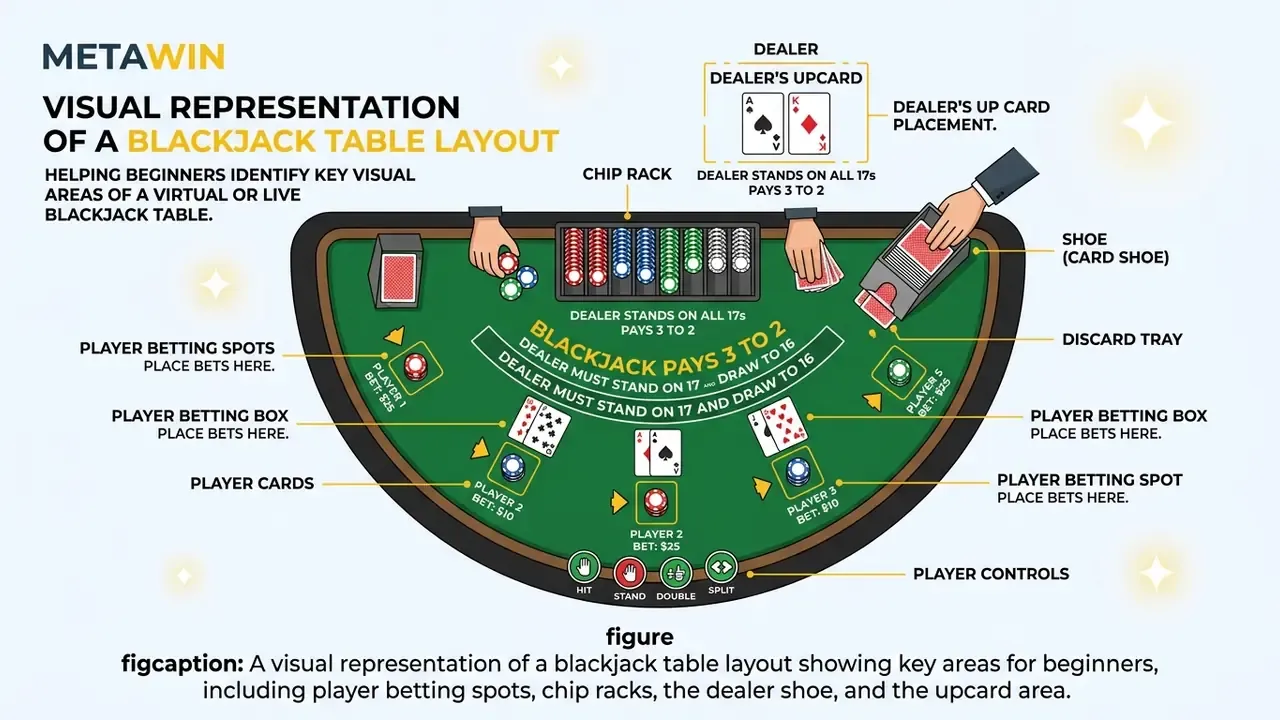
A round begins when the betting window opens. Players pick a chip denomination and place a blackjack bet inside the designated betting circle on the blackjack table.

Once wagers are confirmed, the deal proceeds in clockwise order:

  1. Each player receives one card face up.
  2. The dealer receives one card face up (the "upcard").
  3. Each player receives a second card face up.
  4. The dealer takes a second card face down (the "hole card") in games played under American rules. Updated: under European-style rules, the dealer takes the second card only after all players have completed their hands, a sequencing difference documented in published table-game rule sheets such as the Blackjack Game Rules issued by the Washington State Gambling Commission (revised April 2018). Because this variation appears in operator and regulatory rule sheets rather than peer-reviewed research, treat the sequencing as table-specific and confirm it in the in-client rules panel before wagering.

If the dealer's upcard is an Ace or a 10-value card, the dealer may check the hole card immediately (peek) for a natural blackjack. If the dealer holds one, the hand ends right away, dealer blackjacks collect all standard player bets, and players holding natural blackjacks tie the hand.

How to Place a Blackjack Bet

When to Choose Hit, Stand, or Double

Once the initial cards land, each player acts on their own hand. The tactical choices available at the table are:

  • Hit:request an additional card to increase your total. You can hit as often as you like, as long as your total stays at or below 21.
  • Stand:decline further cards and keep your current total. Your turn ends and the total is compared with the dealer's final hand.
  • Double down:double your initial wager in exchange for exactly one additional card, after which your turn ends automatically. Usually chosen when your first two cards total 9, 10, or 11 against a weak dealer upcard.
  • Split:if your first two cards share the same rank (a pair of 8s, a pair of Kings), you can divide them into two separate hands. You must post a second bet equal to your original stake. The dealer separates the cards, deals a second card to each, and you play both hands independently.
  • Surrender (where offered):forfeit the hand after the initial deal and take back 50% of your stake. "Late surrender" is permitted only after the dealer has checked for a natural blackjack.
When to Choose Hit, Stand, or

Dealer Rules, Insurance, and Round Resolution

Players get discretion. The dealer does not; the dealer follows fixed procedures set by the table rules:

  • Dealer drawing rules:the dealer must hit on any total of 16 or less. On 17 or higher, the action depends on the table specification:
  • Stand on Soft 17 (S17):the dealer must stand on all totals of 17 or higher, including soft 17 (Ace + 6).
  • Hit on Soft 17 (H17):the dealer must draw another card on soft 17, which increases the house edge against the player.
Dealer Rules, Insurance, and Round Resolution

«The formal model confirms that the H17 instruction raises the player's expected loss, because the dealer gains additional opportunities to convert weak soft totals into stronger final hands.» Li et al., A Formal Game-Theoretic Model of Blackjack, SSRN preprint (2024). https://ssrn.com

Operator rule sheets, for example the published blackjack and Infinite Blackjack rules used by state-owned operators such as Loto-Québec, describe the same mechanic in procedural terms ("hit on 16 or less, stand on soft 17 or more"), but they do not quantify the edge impact. That is why the academic model above is the stronger reference for the mathematical consequence.

  • Insurance wager: if the dealer's upcard is an Ace, the table offers an optional side bet called insurance. It costs up to half your initial wager and pays 2:1 if the dealer's hidden card is a 10-value card, giving the dealer blackjack. If the dealer does not have blackjack, the insurance bet is lost and the main hand continues. Mathematically, insurance carries a significant house advantage and is generally unfavourable for standard play.
  • Round resolution: after all players finish their turns without busting, the dealer reveals the hole card and draws until reaching a final total under house rules. Totals are then compared against each active player hand and wagers are settled.
Operator rule sheets, for example the

Special Table Rules and Terminology Glossary

Beyond the core actions, individual tables layer on secondary conditions that quietly move the house edge in either direction. Read the game info panel before you sit down. Two tables with identical branding can carry materially different rules, and the difference is real money.

Table 2: Special table rules, player options, and secondary conditions

Rule / TermMechanical DefinitionMathematical / Operational Impact
Bet BehindPlacing a wager on another seated player's hand while you wait for an open seat.You inherit every decision made by the seat holder; your result depends entirely on their strategy quality. At some live tables, bet-behind slots are unlimited.
10 Card CharlieRule under which a player automatically wins after drawing ten cards without busting.Extremely rare (well under 0.001% of hands); marginally reduces the house edge when active. Some tables use 5-Card or 7-Card Charlie variants, which matter far more.
Double Any 2Doubling down is permitted on any initial two-card combination.The player-friendly baseline; maximises value on soft doubles such as Ace+6 against a dealer 5.
Double 9–11 OnlyDoubling restricted to hard totals of 9, 10, or 11.Increases the house edge by roughly +0.09% compared with "Double Any 2 Cards".
Hit Split AcesAllows drawing more than one additional card after splitting Aces.Strongly favourable to the player. Most standard tables restrict split Aces to exactly one card each.
ResplitOption to split again when a third card of matching rank appears (up to 3 or 4 hands).Reduces the house edge by approximately 0.05%; standard under Atlantic City rules.
Surrender / Late SurrenderForfeit the hand for 50% of the stake, after the dealer's blackjack check.Useful on hard 16 against a dealer 10 or Ace; lowers the house edge when used correctly.
Side BetsOptional secondary wagers (Perfect Pairs, 21+3, Lucky Ladies, Buster Blackjack, Top 3).Higher potential payouts, but house edges typically between 5% and 11%. Note that some regulated tables prohibit back betting on side bets.
Dealer 22 PushesVariant rule (Blackjack Switch, Free Bet Blackjack) where a dealer total of 22 pushes all non-busted player hands.Compensates the casino for other player-friendly features; significantly reduces the value of strong player totals.

A quick habit worth building: before your first bet at any new blackjack table, screenshot the rules panel. If a dispute ever reaches support, you will have the rule set as it appeared to you.

Types of Blackjack Games: Classic, Demo, and Live Dealer

Modern online casinos run several distinct blackjack formats. The right one depends on whether you want practice, fast solo play, or a social live casino environment, and on mobile it also depends on how stable your connection is.

Classic Blackjack and RNG Formats

Classic online blackjack relies on a certified Random Number Generator (RNG) to determine card outcomes. In RNG blackjack games there is no physical deck and no human dealer; software simulates the shuffle and the draw for every round.

Key characteristics of software RNG blackjack:

  • Instant speed:cards are dealt the moment you click, with no waiting for other players or physical dealing time.
  • Flexible stakes:minimum bets often start very low (₹10 to ₹50), which makes RNG tables practical for testing basic mechanics.
  • Low data consumption:RNG tables are lightweight and typically use only a few megabytes per hour, so they remain playable on slower 3G/4G connections and in areas with patchy coverage.
  • 3D and First Person formats:titles such as Evolution's First Person Blackjack offer detailed 3D animated environments with adjustable dealing speeds ("Fast" or "Normal") and up to five selectable hands per round. Updated: these specifications come from studio product documentation rather than independent testing labs, so treat feature lists as vendor-published rather than independently audited. Several First Person titles also include a "Go Live" button that transfers you directly to the matching live dealer table.
Classic Blackjack and RNG Formats. Classic

All certified RNG software used by reputable platforms must meet technical randomness standards: outputs have to be uniformly distributed, unpredictable, non-cyclic, and resistant to predictable seeding (UK Gambling Commission RTS 7; Danish Spillemyndigheden inspection standards additionally require formal statistical test suites such as DIEHARDER or NIST).

«Online GGY in Great Britain rose 4% year on year to £1.3 billion between October and December 2023, confirming sustained demand for online casino play.» UK Gambling Commission, Market overview, operator data to December 2023 (January 2024). https://www.gamblingcommission.gov.uk

«Blackjack revenue across 37 authorised internet gaming sites reached $213,468,740 in 2023.» New Jersey Casino Control Commission, Annual Report 2023. https://www.njconsumeraffairs.gov

Those figures matter for a practical reason. RNG blackjack is not a niche product; it is a high-volume, heavily audited vertical. That is precisely why licensed operators publish rule sets, RTP data, and certification details you can check before betting.

Blackjack Demo and Free Play Options

A blackjack demo version lets you play the complete game with virtual play-money credits instead of real currency.

Demo modes use the same game logic, card rules, and RNG mechanics as their real-money counterparts. They are an ideal place to:

  1. Learn the table controls without financial exposure.
  2. Experiment with player actions such as splitting pairs and doubling down.
  3. Test basic decision charts in real time, at your own pace.

There is a limit, though. Virtual credits hold no monetary value and cannot be withdrawn or converted to cash. Demo play also does not replicate the psychological pressure of playing with real funds. Experimental research on simulated gambling has found that inflated demo-mode results can increase the size of subsequent real-money bets, so treat a generous demo balance with scepticism rather than confidence.

Blackjack Demo and Free Play Options

Checklist: how to test a blackjack demo safely

  • Launch the demo from the game lobby without registering where the platform allows it; most RNG blackjack titles load in-browser.
  • Never enter card, UPI, or bank details on a demo screen. A demo that demands payment credentials is a marketing funnel, not a practice tool.
  • Ignore countdown timers, "demo expiring" banners, and pop-ups offering instant deposit bonuses. Those are conversion prompts, not game features.
  • Check whether the demo table's rules match the real-money version (deck count, S17/H17, 3:2 versus 6:5). Demo tables sometimes run friendlier rules than the cash tables.
  • Practise one decision set at a time (hard totals first, then soft totals, then pairs) rather than clicking at maximum speed.
  • Log at least 200 demo hands using a basic strategy chart before you even think about a deposit.

Live Blackjack with a Real Dealer

Live dealer blackjack sits between digital software and a physical venue. The game is broadcast in high-definition video from specialised casino studios, with professional croupiers handling real cards.

Key features of live blackjack:

  • Physical equipment:real cards, manual shoes, or continuous shuffling machines (CSMs), monitored by optical card readers that translate each draw into digital overlay data. Studio operations are subject to documented dealing procedures, dealer supervision, and video surveillance requirements.
  • Social interaction:you can talk to the live blackjack dealer, and sometimes to other players, through a chat window. Many tables also support "bet behind", letting you wager on a seated player's hand.
  • Pacing and betting windows:rounds run on a timer, usually 15 to 20 seconds for placing bets, which creates a measured, steady rhythm.
  • Mobile data and connection requirements:live tables stream continuous HD video and typically consume several hundred megabytes to over 1 GB per hour, depending on quality. A stable connection of at least 2–5 Mbps is advisable. On congested mobile networks, dropped frames during a decision window can trigger an automatic stand or a forfeited action, which is a genuine financial risk that simply does not exist on RNG tables. If your connection is unreliable, play RNG or First Person formats instead, or lower the stream quality in settings.
  • No free demo mode:Updated: because studio streaming carries per-table operating costs and seating is finite, live dealer tables are effectively real-money-only, and free demo access is not offered by mainstream studios. This is an industry-wide operating practice reported by live-casino trade resources rather than a regulatory requirement, so confirm availability in the specific lobby you use.
Live Blackjack with a Real Dealer

Table 3: Operational comparison across online blackjack formats

FeatureDemo BlackjackClassic RNG BlackjackFirst Person BlackjackLive Dealer Blackjack
Outcome GeneratorSoftware RNGCertified Software RNG3D Software RNGPhysical Cards and Studio Dealer
Financial RiskNone (Virtual Credits)Real MoneyReal MoneyReal Money
Dealing SpeedUser-controlled (Instant)Instant / FastAdjustable (Fast/Normal)Fixed Studio Pace (15–20s window)
Live Chat FeatureUnavailableUnavailableUnavailableAvailable with Croupier
Mobile Data Use (approx.)MinimalMinimal (few MB/hour)Low to ModerateHigh (hundreds of MB to 1 GB+/hour)
Card Counting ViabilityNone (reshuffle each hand)None (reshuffle each hand)None (reshuffle each hand)Negligible (CSM / ~50% penetration)
Primary PurposeRule Practice and TestingFast Solo Real-Money PlayImmersive Solo PlayAuthentic Casino Experience

The short version: learn in demo, test decisions on low-stake RNG tables, and move to live blackjack only when both your bankroll and your connection can handle it.

Modern Online Blackjack Variations and Unique Rules

Beyond standard tables, software developers and live studios have introduced specialised rules, fee structures, and payout mechanics. Each variation shifts the house edge, so read the paytable before you place a chip:

  • Lightning Blackjack (Evolution):adds a compulsory 100% "Lightning Fee" to every initial wager, so a ₹500 bet costs ₹1,000. Winning hands generate a multiplier (from 2x up to 25x) that is stored and applied to your next winning hand. The fee is the price of the multiplier mechanic, not a bonus.
  • Blackjack X-Change:lets you trade cards mid-hand. You can buy a replacement card to improve a weak holding, or sell a valuable card back to the house for an instant cash payout calculated from the current equity of the hand.
  • Atlantic City Blackjack:played with 8 decks. Permits late surrender, splitting up to three times (four hands), and doubling on any initial two cards. The dealer stands on soft 17 and peeks for natural blackjack, which makes it one of the more player-friendly rule sets online.
  • Double Exposure Blackjack:both dealer cards are dealt face up immediately. To offset that large informational advantage, natural blackjacks pay only 1:1 and the dealer wins all tied hands except against a natural blackjack.
  • Early Payout Blackjack:lets you cash out a hand before the dealer completes their turn. The offer is calculated dynamically from the probability of the current hand state against the dealer's upcard, so the payout can be higher or lower than the original stake. It is not a standard surrender.
  • Blackjack Switch:two hands are dealt with equal wagers, and you may swap the second card of each hand once. In exchange, player blackjacks usually pay even money and a dealer total of 22 pushes all non-busted hands.
  • Free Bet Blackjack:the house funds certain doubles and splits with "free" chips, again balanced by the dealer-22 push rule.
  • Power Blackjack, Blackjack Party, and Vinnie Jones Blackjack:live-studio exclusives that alter deck composition (Power Blackjack removes all 9s and 10s while allowing triple and quadruple downs) or the presentation layer (hosted, entertainment-led tables).
Modern Online Blackjack Variations and Unique

Because variant rules can swing the house edge by a full percentage point or more, the practical rule is simple: never learn a variant with real money before you understand the baseline game.

How to Choose a Blackjack Casino and Evaluate Offer Value

Disclaimer: this information is general in nature and does not replace legal, tax, or financial advice. Real-money online gambling is regulated by the laws of each jurisdiction; users are responsible for independently verifying the legal status of online gaming in their own region before registering or depositing funds.

Choosing a reliable platform means looking past marketing claims and big bonus figures. A player-first evaluation puts legal compliance, secure payment processing, clear terms, and functional safety features first.

Which Casino Terms to Check Before Playing

Before registering or depositing at any blackjack casino, verify these core trust indicators:

  1. Licensing and regulatory oversight: confirm the platform operates under a verified gaming licence (Malta Gaming Authority, UK Gambling Commission, or a Curaçao licence, for example). Updated: Curaçao's framework changed materially when the National Ordinance on Games of Chance (LOK) took effect on 24 December 2024, converting legacy master-licence sublicences into provisional licences issued directly by the Curaçao Gaming Authority. Licence conditions under this framework require player funds to be held in segregated accounts, payments to be routed through a registered Player Account, and personal data to be processed under applicable data-protection law. Independent RNG certification is a separate technical requirement, so check for testing-lab seals (eCOGRA, GLI, iTech Labs) in the site footer, and treat an unverifiable licence number as a red flag.
  2. Bonus wagering caps: some regulators cap promotional wagering directly. Under the UK Gambling Commission's LCCP social responsibility code, wagering on bonus funds must not exceed 10x, and a single incentive cannot mix multiple gambling products. France's regulator expects offers to state duration, deposit conditions, reward type, and bonus size explicitly. If an operator claims a licence from a strict regulator but advertises a 60x requirement, the licence claim deserves scrutiny.
  3. India-specific payment friction: for users in India, smooth payment methods matter more than a flashy lobby. Check whether the platform supports direct INR transactions, UPI, and NetBanking. Look for hidden currency conversion fees (INR to EUR/USD and back during withdrawals), which can quietly cost 2–4% per round trip.
  4. Withdrawal rules and KYC terms: review the verification requirements. Reputable casinos require Know Your Customer identity submission (PAN card or Aadhaar details, typically) before authorising withdrawals. Be careful with platforms that accept deposits instantly but impose vague, undocumented delays on payouts.
  5. Responsible gambling controls: licensed operators must publish responsible-gambling information and provide working tools: deposit and loss limits, session timers, reality checks, self-exclusion, and links to help services. Denmark's Spillemyndigheden requires "18+" notices, self-tests, helpline contacts, and ROFUS exclusion information on licensed sites; the UKGC's LCCP requires equivalent access to limits, timers, and self-exclusion. If you cannot find these controls in the account settings within two minutes, treat the platform as unsuitable.

In evaluating payment pathways for Indian users, Casino and Betting India reviewed withdrawal friction across major international platforms. By mapping UPI and NetBanking processing times and flagging hidden currency conversion fees, our editorial framework helped users identify platforms with clear payout windows (see our iGaming methodology and payment review framework for the full assessment criteria and scoring process).

Which Casino Terms to Check Before

Payments, KYC, and Withdrawals for Players in India

Most withdrawal complaints are not caused by "rigged" games. They are caused by incomplete verification, name mismatches, or a payment method that was never eligible for payouts in the first place. The table below summarises the realistic profile of each rail.

Table 4: Deposit and withdrawal characteristics by payment method (India)

MethodTypical Deposit SpeedTypical Withdrawal TimeFeesPractical Notes
UPIInstantInstant to 2 hours (after KYC approval)Usually 0% from the operatorPer-transaction and daily limits are set by your bank or app, not the casino. The UPI ID must match the verified account holder name.
NetBanking / IMPS / Bank TransferInstant to 30 minutes1–3 business daysUsually 0%; occasional bank chargesMost reliable for larger amounts; slowest on weekends and bank holidays. Beneficiary name must match your KYC documents exactly.
E-wallets (where supported)Instant2–24 hoursOperator-dependent; conversion spreads commonWatch for INR to USD/EUR conversion on both legs of the transaction.
Cryptocurrency10–30 minutes10–30 minutesNetwork or withdrawal fee (variable)Fast, but adds asset-price volatility and extra tax-reporting complexity. Wrong-network transfers are unrecoverable.
Prepaid vouchers / cardsInstantNot available for withdrawalPurchase fee possibleDeposit-only in most cases; you will need a second, withdrawable method.

KYC readiness checklist, prepare this before your first deposit

  • Identity proof: PAN card (clear, uncropped, all four corners visible).
  • Address proof: Aadhaar, passport, driving licence, or a utility bill dated within the last 3 months.
  • Payment ownership proof: bank statement header or UPI app screenshot showing your name and the account or VPA you will use.
  • Name consistency: the name on your casino account, your bank account, and your ID must match character for character. Mismatches are the single most common cause of frozen withdrawals.
  • Same-method rule: most operators require withdrawals to the same method used for the deposit. Choose a withdrawable rail from the start.
  • Submit early: complete verification right after registration, not after you win. Verification queues are slowest at month-end.
  • If a payment stalls: capture the transaction reference (UTR for UPI/IMPS), the timestamp, and a screenshot; open a support ticket in writing rather than live chat only, and ask for the expected processing SLA in the reply. If funds remain unaccounted for beyond the published window, escalate to the licensing authority named in the site footer.

Taxation note (India): winnings from online games are subject to tax under Indian income-tax provisions, including tax deducted at source on net winnings from online games (Section 194BA of the Income-tax Act), and deposits to real-money gaming platforms have been subject to GST at 28% following the 2023 GST Council decision. Rates, thresholds, and applicability change, and treatment can differ for offshore operators. Consult a qualified tax professional about your personal position; this article does not constitute tax advice.

How to Evaluate Bonus Offers and Wagering Terms

Casino welcome bonuses love a big number: "100% up to ₹20,000". The real value of an offer, though, depends almost entirely on its terms and conditions.

«Many gamblers misinterpret return-to-player information, treating a high percentage as a guarantee of short-term return rather than an average long-run loss.» Addiction (Wiley, 2023), experimental study of RTP presentation formats. https://onlinelibrary.wiley.com

The same misreading applies to bonus headlines. A large nominal figure describes marketing generosity, not expected value. What determines value is the arithmetic below.

  • Wagering requirements (playthrough):the multiplier showing how much you must bet before bonus funds convert to withdrawable cash (30x bonus amount, for instance). Check whether the multiplier applies to the bonus alone or to deposit plus bonus; the latter effectively doubles the workload.
  • Game contribution rate:critical for blackjack players. Because blackjack has a high RTP, many casinos restrict its contribution toward wagering to 10% or lower, or exclude table games entirely.
  • Example calculation: with a ₹1,000 bonus at 30x (₹30,000 in required bets) and a 10% contribution rate, every ₹100 bet on blackjack counts as only ₹10 toward the requirement. Your actual playthrough on blackjack is ten times larger: ₹300,000 in total wagers.
  • Maximum bet caps:most active bonuses impose a strict per-hand wager limit (₹400 or $5, typically). Exceeding it while playing with bonus funds can forfeit the bonus and any winnings attached to it.
  • Expiry windows:requirements are usually time-boxed (7 to 30 days). A large bonus with a short window and a low contribution rate is mathematically unclearable, no matter how well you play.
Metawin heading-banner

Quick calculator reference: true wagering cost on blackjack

Formula: Total Wagers Required = (Bonus Amount × Wagering Multiplier) ÷ Blackjack Contribution Rate

Worked examples on a ₹10,000 bonus with a 30x requirement:

ScenarioContribution RateTotal Bets Required
Standard slot play100% (1.00)₹300,000
Standard blackjack play10% (0.10)₹3,000,000
Restrictive blackjack play5% (0.05)₹6,000,000
Blackjack excluded0%Not clearable via blackjack

How to use it: divide the required turnover by your average bet size to estimate the number of hands. At ₹200 per hand and a 10% contribution rate, ₹3,000,000 in turnover equals 15,000 hands, roughly 150 hours of live play at 100 hands per hour. Then multiply the turnover by the house edge (say 0.6%) to estimate expected cost: ₹3,000,000 × 0.006 ≈ ₹18,000 in expected losses to unlock a ₹10,000 bonus.

Rule of thumb: if the blackjack contribution rate is below 10%, clearing a casino bonus through blackjack is mathematically non-viable, and the expected outcome is bankroll exhaustion driven by wagering volume. In that case, decline the bonus and play with cash funds under normal withdrawal terms.

Why Game Variations Matter When Choosing a Casino

Table rules vary widely across online platforms, and they can move the house advantage more than most players expect:

  • Blackjack payout (3:2 versus 6:5):always check the paytable. A 3:2 table gives you ₹1,500 on a ₹1,000 natural blackjack. A restrictive 6:5 table gives you ₹1,200 for the same hand. The 6:5 format raises the house edge by roughly 1.39%, which is a lot to give away for nothing. Some jurisdictions (Maryland, for example) require the payout format to be posted at the table; online, look for it in the game rules panel.
  • Deck count and shuffling:fewer decks generally favour the player, but many low-deck tables offset that with 6:5 payouts or H17. Judge the rule set as a package, not by deck count alone.
  • Side bets inventory:platforms often add secondary wagers such as 21+3 (poker hands formed from your two cards plus the dealer upcard), Perfect Pairs, Lucky Ladies, Buster Blackjack, or Top 3. Some regulated live tables carry six independent side bets on a single blackjack layout. The payout odds look attractive (25:1 for matching pairs, for example), but the house edge is far higher than the main game, typically 5% to 11%.
Why Game Variations Matter When Choosing

«Pennsylvania iGaming table-game revenue rose 18.58% year on year to $44,914,620 in May 2024, reflecting rapid expansion of the online table-game market.» Pennsylvania Gaming Control Board, May 2024 Revenue Press Release. https://www.pgcb.pa.gov

Rapid market growth means more tables, more variants, and more rule permutations competing for your deposit. Which makes rule-set comparison a genuine, unglamorous edge for the informed player.

Legal disclaimer and jurisdiction notice: Gambling regulations vary by jurisdiction. In India, real-money online gaming is strictly governed under state laws and national statutes, including the Promotion and Regulation of Online Gaming Act, 2025, which addresses online money games involving bets, wagers, or other stakes. Users must verify the legal status of online real-money play in their specific state, observe age restriction requirements (18+ or 21+ depending on local jurisdiction), and review all operator terms before playing.

Blackjack Strategy for Beginners: Decision-Making Without Income Promises

Blackjack stands out among casino games because mathematical strategy genuinely influences the expected outcome of each hand. But let us be precise about what that means: blackjack strategy minimises expected losses. It does not guarantee profit, and it does not turn gambling into income.

Core Decisions Based on Player Hand and Dealer Upcard

The mathematically optimal way to play every hand is known as basic strategy. It rests on probability models that calculate the highest expected value for each combination of player total and dealer upcard.

«Optimal play is derived by evaluating each decision node against the dealer's conditional outcome distribution, producing a fixed action for every player total and dealer upcard.» Li et al., A Formal Game-Theoretic Model of Blackjack, SSRN preprint (2024). https://ssrn.com

Academic analyses put the effect in context: playing basic strategy instead of intuition reduces the house edge from mid-single-digit percentages down to roughly 0.5% to 2%, depending on the rule set and on whether splitting and doubling are permitted.

Key fundamentals from basic strategy charts:

  • Hard hand decisions:
  • Hard 8 or lower:always hit.
  • Hard 9:double down if the dealer shows 3 through 6; otherwise hit.
  • Hard 10 or 11:double down when your total beats the dealer's upcard (double 10 against dealer 2–9; double 11 against dealer 2–10); otherwise hit.
  • Hard 12 to 16:stand against a weak dealer upcard (2 through 6). Hit against a strong upcard (7 through Ace), because the dealer is likely to finish with a strong total.
  • Hard 17 or higher:always stand.
  • Soft hand decisions:
  • Soft 13 to 17 (Ace + 2 to Ace + 6):double down against dealer 4 through 6; otherwise hit.
  • Soft 18 (Ace + 7):double down against dealer 3 through 6; stand against 2, 7, or 8; hit against 9, 10, or Ace.
  • Soft 19 or higher:always stand.
  • Pair splitting rules:
  • Always split:pairs of Aces and pairs of 8s. Splitting Aces gives you two shots at a soft 11; splitting 8s breaks up a weak hard 16.
  • Never split:pairs of 10s (keep the strong 20) and pairs of 5s (treat as hard 10 and double against weak dealer upcards).
Metawin heading-banner

One caveat that beginners often miss. Chart cells shift with the rule set: single-deck, double-deck, and multi-deck games, plus tables that forbid double-after-split, each need their own chart. A chart printed for one rule set and applied to another quietly gives back part of the edge you were trying to protect.

Expert note on variant research: "Before attempting complex rule variations or side wagers, master the baseline probabilities of standard multi-deck play. Evaluating rule variations through independent mathematical databases, such as Michael Shackleford's Wizard of Odds analysis, ensures you understand the exact house edge impact of table-specific terms before placing real funds." This mirrors long-standing advice from published gambling authors: Andrew Brisman, author of the American Mensa Guide to Casino Gambling, has recommended researching a variation's house edge and correct strategy before playing it, and points readers to wizardofodds.com for variant-by-variant analysis.

Betting Strategies and Why They Do Not Guarantee Wins

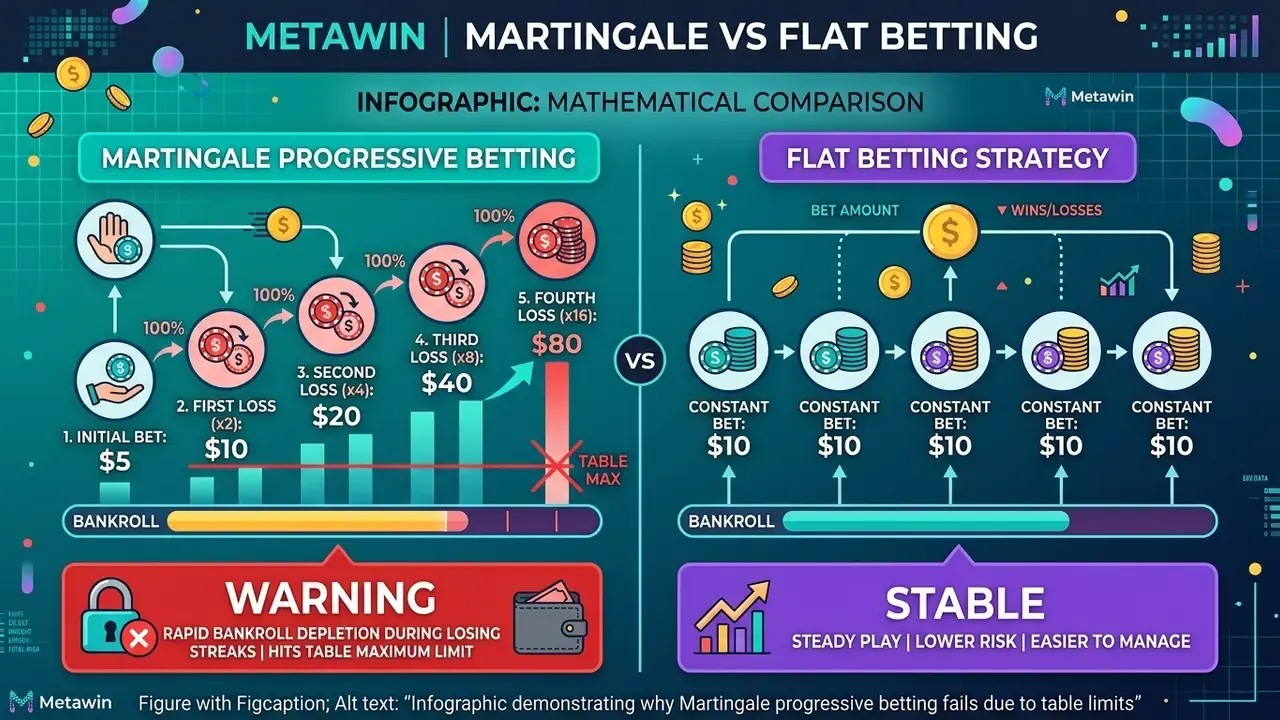
Progressive betting systems, such as the Martingale strategy (doubling your wager after every loss) or the Paroli / winning streak strategy (increasing wagers after wins), get discussed endlessly online. Probability theory is blunt about them: no betting progression can overcome the underlying house edge.

«Structural game characteristics such as RTP and volatility are fixed; betting systems alter only variance and the speed of loss, not expected return.» Gambling harm prevention and harm reduction in online environments: A scoping review, Harm Reduction Journal (2023). https://harmreductionjournal.biomedcentral.com

Mathematically, progressive systems fail for two reasons:

  1. Finite bankroll and table limits: a run of losses forces exponential wager growth under Martingale (₹10, ₹20, ₹40, ₹80, ₹160, ₹320, ₹640 and onward). To survive n consecutive losses you must already have committed roughly 2ⁿ minus 1 base units, plus headroom for the next double. Sooner or later you hit either your personal bankroll ceiling or the table maximum, and recovery becomes impossible by design.
  2. Independent events: each hand is an independent event, drawn from a reshuffled or reset shoe. Past losses do not raise the probability of a future win. The Paroli system inverts the progression by raising stakes after wins, which concentrates exposure at the top of a streak, so one loss surrenders the accumulated profit. Either way, expected value per hand stays negative.
Mathematically, progressive systems fail for two

«Across 1,743 online casino gamblers in the UK, Canada, and Spain, a monthly standard deviation of daily wagers above €35.14 was a leading machine-learning marker of self-reported problem gambling.» Using Artificial Intelligence Algorithms to Predict Self-Reported Problem Gambling Among Online Casino Gamblers, International Journal of Mental Health and Addiction (2024). https://link.springer.com

In other words, the erratic bet sizing progressive systems require is itself a documented risk indicator. Not a documented route to profit.

Card Counting: Limitations for Online and Live Blackjack

Card counting (the Hi-Lo system, for example, where low cards 2–6 add +1, neutral cards 7–9 count as 0, and high cards 10 to Ace subtract 1, with the running count divided by the decks remaining to give a true count) tracks the ratio of high cards left in a physical shoe. Effective in theory in land-based games with deep shoe penetration. Online, it runs into structural walls:

  • Online RNG blackjack:the software reshuffles the virtual deck completely after every single hand. Deck composition resets continuously, so counting is impossible. Note that some publishers still market "card counting" as a way to lower the house edge in online blackjack. For RNG tables, that claim is simply incorrect.
  • Live dealer online blackjack:live streams often use continuous shuffling machines, or reshuffle halfway through an 8-deck shoe (around 50% penetration). Because cards return to the shuffler during play, the composition of unseen cards is repeatedly reset, which removes the statistical concentration counting depends on.
  • Operational countermeasures:even where penetration is deeper, bet-spread monitoring, unlimited bet-behind participation, and table-limit changes make sustained advantage play impractical in a streamed environment.
Card Counting Limitations for Online and

E-E-A-T compliance and fact check:

  • RTP and house edge: under standard multi-deck rules with perfect basic strategy, the house edge in blackjack ranges between 0.5% and 1.5% (a return to player of 98.5% to 99.5%). Published academic notes place the theoretical floor near 0.16% under the most favourable rule sets, while regulator-published figures for restrictive variants have been documented as low as 87.11% RTP. A useful reminder that "blackjack" is a family of games, not a single house edge.
  • No 100% winning method: no system, strategy chart, or betting software can promise guaranteed profits or remove the house edge. Casino play must be treated strictly as paid entertainment with financial risk, never as an investment or a shortcut to income.

Disclaimer: no strategy, betting system, or software guarantees a profit. Casino play involves financial risk and should be treated exclusively as paid entertainment. If gambling stops feeling like entertainment, use the operator's self-exclusion tools and contact a qualified support service.

How to Start Playing Blackjack Online for Real Money

Moving from free information or demo practice to real-money play deserves a structured, safety-first approach. Regulatory guidance in major markets requires operators to verify a player's name, address, and date of birth before allowing play or deposits, so treat identity checks as a normal part of onboarding rather than an obstacle.

[CHECKLIST: Step-by-step visual verification list for players before making a first real-money deposit. Style: clean UI card list.]
Purpose: Provides a clear, practical safety sequence covering licensing, INR payment terms, limit setting, and table selection.
Semantics: Accessible structured layout with all checklist items duplicated as plain text in the DOM.
How to Start Playing Blackjack Online

Moving from Blackjack Demo to Real Money Play

Real money brings financial risk and emotional pressure, and the second one is easy to underestimate. Laboratory research on blackjack has documented measurable physiological arousal, including elevated heart rate and stress-hormone response, during real-stakes play, and decision errors under table pressure skew heavily toward omission (failing to act correctly) rather than commission. Set clear boundaries before your first deposit:

  1. Set a pre-determined budget: allocate money you can afford to lose entirely, without touching essential living expenses, utility bills, or savings.
  2. Establish loss and time limits: use the casino's responsible gambling dashboard to set daily, weekly, or monthly deposit limits, plus session time reminders (reality checks).
Moving from Blackjack Demo to Real

«Deposit limits, time restrictions, and pop-up reminders reduce session intensity, although the overall quality of evidence remains mixed.» Gambling harm prevention and harm reduction in online environments: A scoping review, Harm Reduction Journal (2023). https://harmreductionjournal.biomedcentral.com

  1. Separate entertainment from income: treat your deposit as the cost of an entertainment session, like a match ticket or a cinema booking. Never chase losses with extra deposits to recover what is gone.

«Frequent in-session deposits and balance-depletion events were stronger predictors of problem gambling than absolute wagering volume.» Using Artificial Intelligence Algorithms to Predict Self-Reported Problem Gambling Among Online Casino Gamblers, International Journal of Mental Health and Addiction (2024). https://link.springer.com

The practical implication is direct. The "top-up mid-session" button matters more than the size of any single bet. Where the platform allows it, set a hard daily deposit cap that cannot be raised instantly.

Choosing a Blackjack Table, Bet Limits, and Dealer Format

In the real-money lobby, pick a blackjack table that matches your budget rather than your ambition:

  • Check minimum bet limits:choose a table where the minimum bet is no more than 1% to 2% of your session bankroll. With a ₹5,000 session budget, that means a ₹50 or ₹100 minimum, enough to absorb normal variance.
  • Confirm table rules:inspect the layout and rules panel to verify that natural blackjacks pay 3:2, that the dealer stands on soft 17 (S17), and, where available, that doubling is allowed on any two cards and resplitting is permitted.
  • Check the maximum limit too:a table maximum only a few multiples above the minimum restricts your ability to play doubles and splits correctly on a larger bankroll.
  • Select your preferred format:for fast solo play at micro-stakes, or if your mobile connection is shaky, choose a classic RNG or First Person table. For a traditional pace with physical cards, and with a stable high-bandwidth connection, join a live dealer table.
  • Verify before you win, not after:complete KYC and confirm that your chosen payment method is eligible for withdrawals before you build a balance worth cashing out.
Choosing a Blackjack Table, Bet Limits

One last nudge before the CTA everyone expects: there is no rush. Reading the rules panel costs you a minute, and unclear terms cost far more.

FAQ: Frequently Asked Questions About Online Blackjack

Can I play online blackjack on mobile devices in India?

Yes. Most licensed online casinos offer web-optimised mobile interfaces and dedicated Android or iOS apps, and mobile blackjack formats support both software RNG and live dealer streams. RNG tables use minimal data and tolerate weak connections, while live dealer streams can consume several hundred megabytes to more than 1 GB per hour and need a stable 2–5 Mbps link. On congested networks, a dropped frame during a betting window can trigger an automatic stand, so prefer RNG formats when your connection is unreliable. Always use a secure network and confirm that deposit limits and self-exclusion controls are reachable inside the mobile interface.

Is online blackjack legal in India?

The position depends on national statutes and on your state. India's Promotion and Regulation of Online Gaming Act, 2025 addresses online money games involving bets, wagers, or stakes, and several states, including Telangana, Andhra Pradesh, Tamil Nadu, Assam, and Odisha, apply strict prohibitions on staking money on online games. Sikkim, Nagaland, and Meghalaya operate their own licensing regimes, while Goa and Sikkim permit certain land-based casino operations. Verify your own state's position and consult a qualified legal adviser before playing; this article is general information, not legal advice.
How long do withdrawals to UPI or NetBanking take?

Once KYC is approved, UPI payouts typically clear from instantly to within about two hours, while NetBanking or IMPS transfers usually take one to three business days. Crypto withdrawals are often processed within 10–30 minutes but carry network fees and price volatility. The most common cause of delay is a mismatch between your casino account name, your ID documents, and your bank or UPI account holder name. Keep the transaction reference (UTR) for any pending payment and raise issues in writing with support.

What documents do I need for KYC?

Most licensed operators request a government photo ID (PAN card is standard in India), proof of address dated within three months (Aadhaar, passport, driving licence, or utility bill), and proof of payment ownership such as a bank statement header or a UPI app screenshot showing your name. Submit these immediately after registration rather than after a win, because verification queues are slowest at month-end and during promotional periods.

Do I pay tax on blackjack winnings in India?

Winnings from online games are taxable in India, and tax is deducted at source on net winnings from online games under Section 194BA of the Income-tax Act. Deposits to real-money gaming platforms have also attracted GST at 28% following the 2023 GST Council decision. Rates, thresholds, and applicability change over time and can differ for offshore operators. Consult a qualified tax professional about your specific circumstances.

What is First Person Blackjack and how does it differ from live dealer play?

First Person Blackjack, developed by studios such as Evolution, is a 3D software-based RNG game. It offers high-definition animated graphics, up to five selectable hands per round, and solo play without a physical dealer or fixed time limits per turn. Several First Person titles include a "Go Live" button that transfers your session directly to the matching live dealer table if you want to switch formats. The core difference is the outcome generator: certified RNG software versus a monitored physical deal.

What are popular side bets like Perfect Pairs and 21+3?

Side bets are optional secondary wagers placed alongside your main blackjack bet. Perfect Pairs wins if your first two cards form a pair, paying more for matching suits (mixed pair, coloured pair, perfect pair). 21+3 combines your two cards with the dealer's upcard to form three-card poker hands (flush, straight, three of a kind, straight flush). Other common options include Lucky Ladies, Buster Blackjack, and Top 3. Payouts look bigger, but the house edge is much higher than standard blackjack play, typically 5% to 11%, and some regulated tables prohibit back betting on them.

What is Blackjack Surrender and when can it be used?

Blackjack Surrender lets you forfeit your hand immediately after the initial deal in exchange for 50% of your original wager. "Late surrender" allows this only after the dealer checks for a natural blackjack, and it must be used before doubling or splitting. It is typically correct in genuinely bad spots, such as holding a hard 16 against a dealer Ace or 10 upcard.

What is Blackjack Switch and how does it work?

Blackjack Switch is a variant where you play two hands at once with equal wagers. After the deal, you may swap the second card of each hand to build stronger combinations. To compensate for that advantage, natural blackjacks usually pay even money (1:1), and a dealer total of 22 pushes against all non-busted player hands except a natural blackjack.

Why does Lightning Blackjack charge a fee on every hand?

Lightning Blackjack adds a compulsory 100% "Lightning Fee" to each initial wager, so a ₹500 bet is deducted as ₹1,000. The fee funds the multiplier mechanic: a winning hand generates a multiplier between 2x and 25x that is stored and applied to your next winning hand. It is a paid feature, not a bonus, and it changes the effective cost per hand, so factor it into your bankroll planning before playing.

Can I clear a casino bonus by playing blackjack?

Rarely, and usually not profitably. Blackjack typically contributes 10% or less toward wagering requirements, and some operators exclude table games entirely. A ₹10,000 bonus with a 30x requirement needs ₹300,000 in turnover at 100% contribution, but ₹3,000,000 at a 10% rate. Multiply that turnover by the house edge to estimate your expected cost; if it exceeds the bonus value, decline the offer and play with cash funds instead.

Does card counting work in online blackjack?

No. RNG blackjack reshuffles the virtual deck after every hand, so no count can persist. Live dealer tables use continuous shuffling machines or reshuffle at roughly 50% shoe penetration, which erases the card-composition signal the Hi-Lo system depends on. Claims that counting lowers the house edge in online blackjack are inaccurate for both formats.

Key Takeaways for Safe Play

  • Always review table rules to confirm 3:2 blackjack payouts and S17 dealer rules, and check the special-rule glossary items (Double 9–11, Hit Split Aces, Resplit, Surrender) before you sit down.
  • Account for low game contribution rates, often 10% or less, when reviewing casino bonuses, and run the turnover formula before accepting any offer.
  • Treat basic strategy as a tool to reduce the house edge, not as a profit promise, and verify variant house edges through independent mathematical databases before playing exotic tables.
  • Prepare PAN, address proof, and payment-ownership documents before your first deposit, and choose a withdrawable payment rail from the start.
  • Set strict deposit and time limits, and treat all real-money play as paid entertainment with a fixed stop point.

About This Guide

This guide was produced by the Casino and Betting India editorial team and reviewed by Nisha Rao, Casino Content Editor, an editorial persona specialising in operator terms, payment friction, and responsible-gambling controls for players in the Indian market. Our review framework assesses licensing verifiability, RNG certification, bonus term fairness, INR payment routing, KYC turnaround, and the availability of deposit limits and self-exclusion tools. Methodology details and the payment-review criteria used above are documented in our iGaming methodology and payment review framework.

Responsible gambling reminder: gambling must be treated as entertainment with a cost, never as income. If your play stops being enjoyable, use deposit limits, reality checks, or self-exclusion, and contact a qualified support service in your jurisdiction. This article is general information only and does not constitute legal, tax, financial, or medical advice.